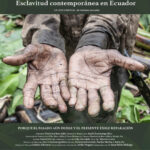
Créditos de la foto: Naku- Caroline Benett. Territorio Sapara. Llanchamacocha-2015

En español: (Dale click)La consulta en el Ecuador
Download the complete research (spanish): Free, prior and informed consultation in Ecuador 2016
Study warns that the application of prior consultation in Ecuador did not keep a strict adherence to the constitutional mandate and the international instruments
Starting from a base line to identify if there exists or not in Ecuador the free, prior, and informed consultation, a report of the Center of Social and Economic Rights – CDES – confirms that in the addressed cases, the conditions of its application do not keep a strict adherence to the constitutional mandate, as to the conventions, and international treaties that rule the sensitive issue.
Emblematic cases as those of Tundayme, San Pablo de Amalí and Sarayaku, attest that the citizen’s consent has not been taken in account with the due process. The consultation in those cases, if there had been, has been substituted by a mere procedure to seem to comply with a requisite contained in the Ecuadorian constitution.
The publication of the Regulation for the execution of the Prior, Free and Informed Consultation in the processes of Tendering and Assignation of Areas and Hydrocarbon Blocks, of July 19th 2012 by means of executive decree, does not possess neither the hierarchy nor the regulatory budget that this matter requires, moving away of the spirit of the Convention 169 of the International Labour Organization and United Nations Declaration on Indigenous Peoples, among others. According to the report, realized by Joaquín López Abad, “there has been of lack of rigor in the procedures and deficiencies in the application of those principles”.
According to Miguel Luzuriaga Fernández, researcher of the CDES, to these arguments, “there must be added the incompliance of the sentence of the Constitutional Court number 001-10-SIN-CC of March 18th 2010, that orders that the prior consultation, established in the article 57, number 7 of the Constitution must be regulated by law (legal reserve) dispatched by the National Assembly.” In his opinion, “this law must also possess the organic hierarchy because it comes from direct constitutional development.”
In the judicial order, the study concludes in recommendations about the implementation of free, prior and informed consultation in harmony with the principles and the spirit of the international instruments, and in prevision of the compliance of sentences such as the one of the Sarayaku case, that would be put into question by the granting of the blocks 79 and 83 in the Amazonia and that will affect moreover to territories of the Shiwiar and Sápara nationalities.